PART 4
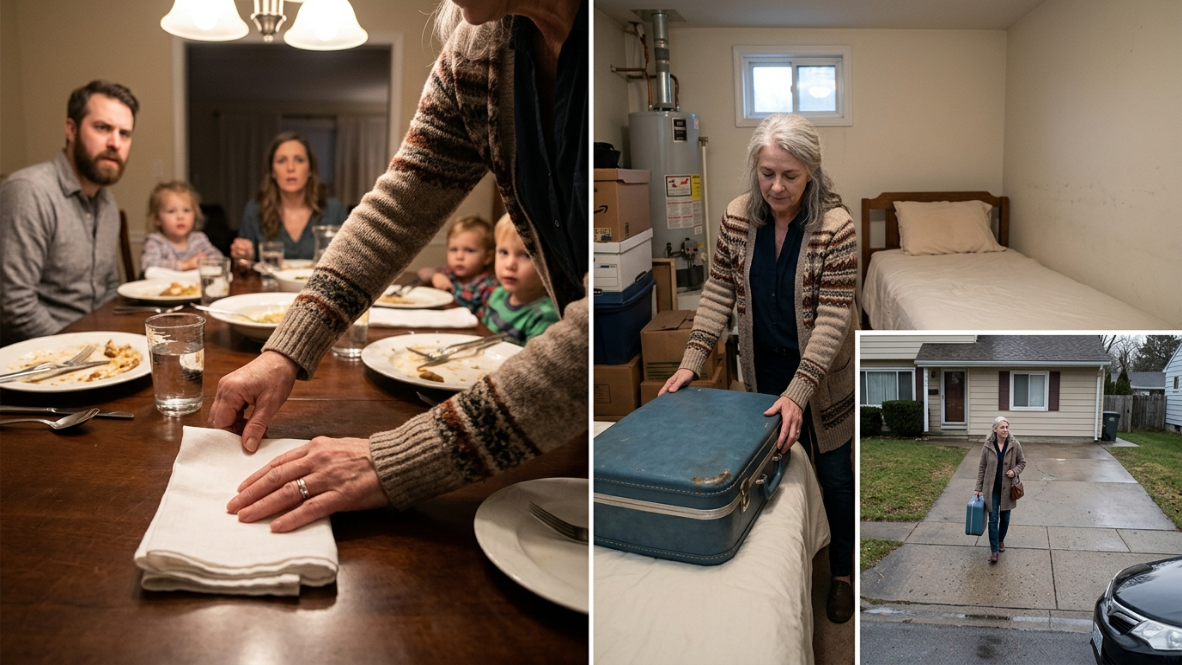
The moment I stepped onto the porch, I expected to feel afraid.
I expected my hands to shake.
I expected the familiar voice inside my head—the one that had spent seventy-two years worrying about everyone else—to tell me I was making a mistake.
But it never came.
Instead, I felt something I had almost forgotten existed.
Peace.
The kind of peace I used to feel sitting on my own porch in Hudson, drinking coffee while the morning sun warmed the wooden steps.
For three months, I had lived in a house that was supposed to be my son’s home, but every day I felt like a guest who had overstayed her welcome.
Now I was walking away.
And somehow, leaving felt more like coming home.
I placed my suitcase beside me and took out my phone.
There was one person I needed to call.
Not Michael.
Not Jessica.
Someone who knew me before I became only “Mom,” “Grandma,” or “the person who helps.”
I called my old neighbor, Margaret.
She answered on the second ring.
“Eleanor?”
Her voice immediately softened.
“I was just thinking about you.”
I smiled sadly.
“That’s strange. I was thinking about you too.”
There was a pause.
Margaret had been my neighbor for twenty years. She knew my husband. She knew the story of my life. She knew how carefully I tended my little house, how I planted flowers every spring, how I sat outside every morning with my coffee and newspaper.
“What happened?” she asked.
I looked back at Michael’s house.
The place where I thought I was rebuilding my family.
The place where I realized I had been rebuilding their convenience.
“I’m coming home.”
Silence.
Then Margaret whispered:
“Your house?”
I closed my eyes.
“Yes.”
“But Eleanor…”
“I know,” I said.
My house was supposed to be gone.
Sold.
A memory.
But there was something Margaret didn’t know.
Something Michael and Jessica didn’t know either.
When I signed the papers for the sale, I had not done it blindly.
I had spent forty-eight years married to a man who believed every decision needed a plan.
My husband, David, used to say:
“Love people with your heart, Eleanor. But protect yourself with your mind.”
I remembered laughing the first time he said it.
I told him:
“You make marriage sound like a business meeting.”
He smiled and replied:
“No. I make marriage sound like two people who care enough about each other to prepare for the future.”
After David died, I kept every important document organized.
Every account.
Every receipt.
Every legal paper.
Because that was the woman I was.
The woman Michael had forgotten.
Before I sold my house, I made one condition clear.
The sale would not officially complete until a waiting period passed.
And during that period, I had the right to reconsider.
I had not told Michael because he never asked.
He only saw the money.
He never asked if I was emotionally ready.
He never asked if I was happy.
He only asked when I could move in.
And now I wondered…
Had he ever actually wanted his mother?
Or had he only wanted what his mother could do?
I spent the night at a small hotel near town.
Nothing fancy.
Just a clean room, a soft bed, and silence.
Real silence.
Not the uncomfortable silence of a family dinner after someone wounds you.
Not the silence of a storage room where you cry quietly so nobody hears.
Peaceful silence.
I placed David’s photograph on the nightstand.
His smile looked the same as always.
“You would have hated that house,” I whispered.
I laughed softly.
“Actually, you probably would have said something much earlier than I did.”
My husband had always been protective of me.
Sometimes too protective.
Years ago, when Michael was twenty-five and wanted to borrow money for a business idea, David warned me.
“Help him if you want,” he said. “But don’t destroy yourself trying to save someone who won’t save himself.”
I had ignored him.
Because I was his mother.
And mothers believe their children will always remember their sacrifices.
Sometimes they do.
Sometimes they don’t.