PART7
I stared at Michael’s message for a long time.
“Mom, please. We need to talk.”
Those words would have once been enough to make me rush back.
That was the old Eleanor.
The mother who dropped everything when her son called.
The mother who drove through snowstorms because Michael forgot his lunch.
The mother who stayed awake all night when he had a fever as a child.
The mother who believed love meant always being available.
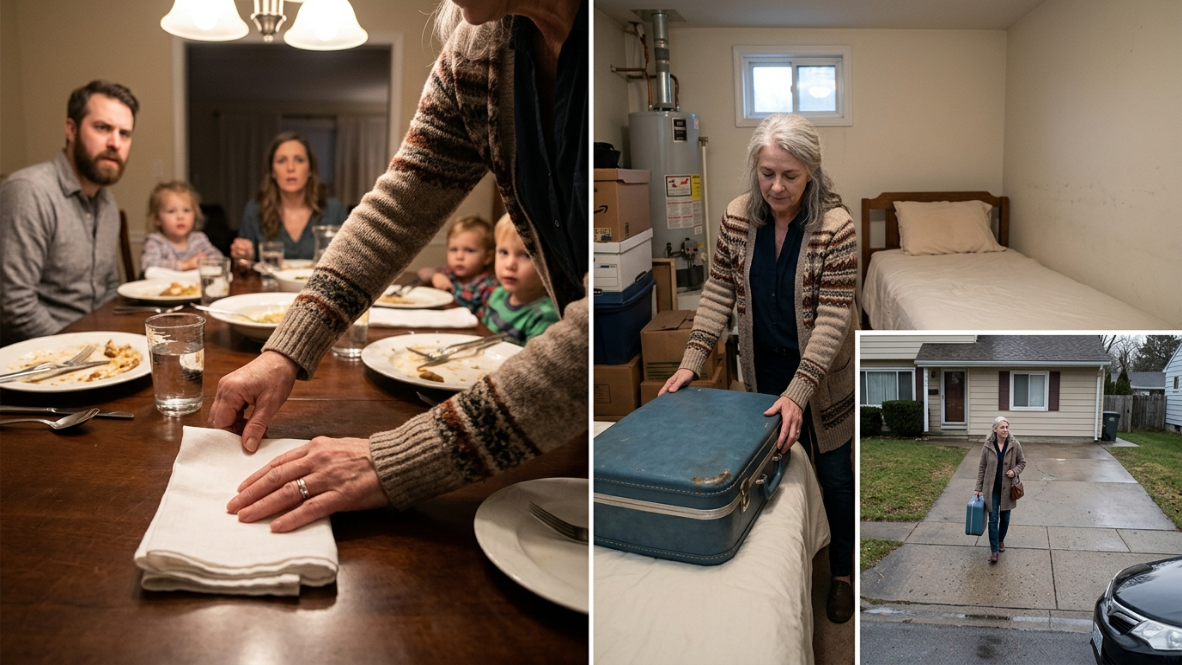
But that woman had spent three months sleeping in a storage room.
That woman had been told, in her own son’s house, that if she didn’t like being used, she could leave.
So I placed the phone face down.
And I went outside to water my flowers.
Because for the first time in years, my own life was waiting for my attention.
Over the next few weeks, I rebuilt my home.
Not just the walls.
Not just the furniture.
My life.
Margaret helped me clean out the old rooms.
We opened windows that had been closed for months.
We washed curtains.
We brought my books out of storage.
I put David’s photograph above the fireplace.
And I placed my rocking chair back on the porch.
Every morning, I made coffee and sat outside.
The same way I had before.
Except now, I appreciated the silence differently.
Before, silence had meant loneliness.
Now, silence meant freedom.
Michael called every day.
At first, I ignored him.
Not because I hated him.
Because I needed him to understand something.
Sometimes when people are used to receiving your love without limits, they do not recognize its value until they no longer have unlimited access to it.
After a week, he stopped calling.
Then came a knock at my door.
I knew who it was before I opened it.
Michael stood there.
But he looked different.
Not physically.
Emotionally.
The confidence was gone.
The attitude was gone.
The man who once stood in his dining room and pointed toward the door looked like someone who finally realized what he had thrown away.
“Hi, Mom.”
I looked at him.
“Hi, Michael.”
The silence between us was uncomfortable.
But this time, I did not rush to fix it.
He did.
“I’m sorry.”
Two words.
Simple.
But heavy.
I leaned against the door.
“For what?”
His eyes dropped.
“For everything.”
I waited.
He swallowed.
“For making you feel like you weren’t family.”
A pause.
“For treating you like you were someone we hired instead of someone we loved.”
Another pause.
“For letting Jessica and me take advantage of you.”
The apology sounded real.
But I had learned something important.
An apology is not proven by words.
It is proven by change.
“Why now?” I asked.
Michael looked confused.
“What do you mean?”
“Why are you sorry now?”
He looked away.
And I saw it.
The truth.
The reason he came.
Not just regret.
Fear.
“I found out about the money situation.”
There it was.
I nodded slowly.
“Your bank account?”
He looked embarrassed.
“Yes.”
I smiled sadly.
“Michael, that’s exactly why I needed to leave.”
He looked at me.
“What?”
“Because even now, the first thing you think about is money.”
His face fell.
“That’s not fair.”
“No?”
My voice remained calm.
“You invited me into your home because you needed help. You accepted my sacrifices because they made your life easier. You expected me to give up my comfort, my independence, and my savings.”
I stepped closer.
“But when I needed one thing from you—respect—you told me where the door was.”
Michael looked like he wanted to argue.
But he couldn’t.
Because he knew.
Every word was true.
A few days later, Jessica came too.
Unlike Michael, she did not apologize immediately.
She stood in my living room, looking around.
At my restored home.
My photos.
My books.
My life.
“I didn’t realize how much this place meant to you,” she said quietly.
I looked at her.
“You never asked.”
She looked down.
That sentence hurt her because it was true.
“I thought you wanted to help.”
“I did want to help.”
I sat down.
“But helping someone does not mean disappearing.”
Jessica sat across from me.
“I was overwhelmed.”
“I understand.”
“And I made mistakes.”
“I know.”
She looked surprised.
“You’re not angry?”
I smiled slightly.
“I was angry.”
I looked toward David’s picture.
“But anger is exhausting. I don’t want to spend the rest of my life carrying something that belongs to someone else.”
Jessica wiped her eyes.
“Do you think you can forgive us?”
I was quiet for a moment.
“Forgiveness does not mean pretending nothing happened.”
She nodded.
“It means I stop allowing what happened to control my future.”
The biggest surprise came from Clare.
A month later, she came to visit me alone.
She walked into my kitchen carrying a small box.
“What’s this?” I asked.
She smiled.
“Something I made.”
Inside were photographs.
Pictures from the years we spent together.
Me teaching her how to bake.
Me helping her with school projects.
Me sitting with her after her first heartbreak.
On top was a handwritten note.
I opened it.
Grandma, thank you for showing me that being kind doesn’t mean letting people hurt you. You taught me the most important lesson anyone ever has. You can love people and still choose yourself.
My eyes filled with tears.
I hugged her.
“Never forget that.”
“I won’t.”
Six months passed.
Michael and Jessica changed.
Not overnight.
Real change rarely happens overnight.
But slowly.
They stopped asking what I could do for them.
They started asking how I was.
Michael began visiting without needing anything.
He fixed the loose step on my porch.
He planted flowers beside my garden.
One morning, while we drank coffee together, he looked at me.
“Mom?”
“Yes?”
“I don’t know if I can ever make up for what I did.”
I smiled.
“You can’t.”
He looked hurt.
“But you can spend the rest of your life doing better.”
He nodded.
“I will.”
And for the first time in years…
I believed him.
One year after I left Michael’s house, I sat on my porch with my coffee.
The same porch.
The same chair.
The same morning sunlight.
But I was different.
My life had taught me something I wished I had learned sooner:
Love is not measured by how much pain you can tolerate.
Sacrifice is not supposed to erase you.
Family is not just about sharing blood.
Family is about the people who remember that your heart matters too.
I looked at David’s photograph beside me.
“I finally listened to you,” I whispered.
I could almost hear his voice.
“It’s about time, Eleanor.”
I laughed.
And for the first time in a long time…
I felt completely at home.
Not because I had a house.
Not because I had money.
Not because I had proven anyone wrong.
But because I had finally remembered something I should have never forgotten:
I belonged to myself first.
And nobody—not even the people I loved most—had the right to take that away.