He nodded slowly.
“I don’t know if I can fix this.”
“You can’t fix the past.”
“I can pay you back.”
“You can try.”
“I will.”
“Good.”
He looked down.
“I’ve already contacted the bank.”
“Why?”
“To start paying the charges.”
I nodded.
“And Sarah?”
“I hurt her.”
“Yes.”
“I know.”
“What are you going to do about that?”
He looked at me.
“I’m going to give her space.”
That was the first answer he had given me that I respected.
Then he said:
“I loved your daughter.”
“I know.”
“I just loved what she could provide for me too.”
The honesty surprised me.
He continued.
“And somewhere along the way, I confused the two.”
I didn’t forgive him.
Not that day.
But I believed him.
And sometimes believing someone is the first step toward deciding what comes next.
Sarah moved out of the house twenty-eight days later.
She didn’t ask me for another extension.
She didn’t ask me for money.
She found a small two-bedroom apartment across town.
It wasn’t glamorous.
There was no private garage.
No designer kitchen.
No giant backyard.
But she paid the rent herself.
On moving day, I helped her carry boxes.
Not because I was returning to the old pattern.
Because she was finally carrying her own boxes too.
At one point, she found an old cardboard box.
Inside were photographs.
Michael.
Me.
Sarah as a child.
Birthdays.
Christmas mornings.
School plays.
Vacations.
Family dinners.
She sat on the floor.
“Mom.”
“What?”
“I don’t remember being this happy.”
I sat beside her.
“You were.”
She looked at a photograph of her father holding her.
“I miss him.”
“So do I.”
She leaned against my shoulder.
“Do you think he would forgive me?”
I looked at the photograph.
“I think he’d want you to do better.”
She nodded.
“I will.”
Six months passed.
I bought a small house near the coast.
Nothing enormous.
Three bedrooms.
A little garden.
A porch facing the water.
For the first time in my life, I chose a home because I liked it.
Not because it was convenient for someone else.
I painted the kitchen.
I bought new curtains.
I planted roses.
And I placed Michael’s photograph above the fireplace.
His old watch sat beside it.
Every morning, I made coffee and sat on the porch.
Sometimes I still felt lonely.
But loneliness felt different when it was chosen.
It no longer felt like rejection.
It felt like peace.
Sarah visited every Sunday.
Sometimes we talked for hours.
Sometimes we argued.
Sometimes we sat silently.
But she began asking questions again.
Real questions.
“How are you?”
“Do you need anything?”
“Can I help?”
And when I answered no, she respected it.
That was how I knew things were changing.
Not because she became perfect.
Because she stopped expecting me to say yes.
One Sunday afternoon, Sarah arrived carrying a small box.
“What is that?”
She placed it on the table.
“I found it in Dad’s old storage things.”
I opened it.
Inside was his wedding ring.
I stared at it.
“I thought this was buried with him.”
“It wasn’t.”
I picked it up.
There was a small note underneath.
I unfolded it.
Michael’s handwriting.
My hands began shaking.
The note was short.
Only one sentence.
“Take care of Ellen, but don’t let her forget to take care of herself.”
I couldn’t speak.
Sarah started crying.
“I think Dad knew.”
I looked at her.
“Knew what?”
“That I’d need to learn this.”
I smiled through my tears.
“Maybe he did.”
She took my hand.
“Mom?”
“Yes?”
“Can I ask you something?”
“Anything.”
“Do you regret giving us the house?”
I thought about it.
Then shook my head.
“No.”
She looked surprised.
“Really?”
“No.”
I smiled.
“I regret giving you everything without teaching you what responsibility meant.”
She nodded.
“That makes sense.”
“I don’t regret loving you.”
She squeezed my hand.
“I don’t regret being your mother.”
She smiled.
“But I do regret forgetting that I was also a person.”
She leaned over and hugged me.
“I’ll never let you forget again.”
A year after that New Year’s Eve, I received a letter.
It was from David.
He had been working steadily.
He had sold several of his expensive electronics.
He was paying back the money.
Slowly.
Not enough to impress anyone.
But enough to prove he was serious.
His letter said:
Ellen,
I used to think losing the house was the worst thing that happened to me.
Now I understand that losing the house was the first honest thing that happened to me.
It forced me to see what I had become.
I don’t expect forgiveness.
I only hope that one day you can believe I finally understand what you tried to teach us.
I folded the letter.
I didn’t send a response.
Not yet.
Some things didn’t need immediate answers.
Then came another New Year’s Eve.
Exactly one year after the night everything changed.
I stood on my porch watching fireworks over the water.
Sarah was beside me.
She held two cups of champagne.
“Mom?”
“Yes?”
“Do you remember last New Year’s?”
I laughed.
“How could I forget?”
She smiled.
“I thought you were destroying our lives.”
“And?”
She looked at the ocean.
“You were giving us ours back.”
I looked at her.
She raised her glass.
“To new beginnings.”
I lifted mine.
“To boundaries.”
She laughed.
“To boundaries.”
We clinked glasses.
Then the fireworks began.
For a moment, I thought about the old house.
The parties.
The bills.
The credit cards.
The study where Michael’s desk had disappeared.
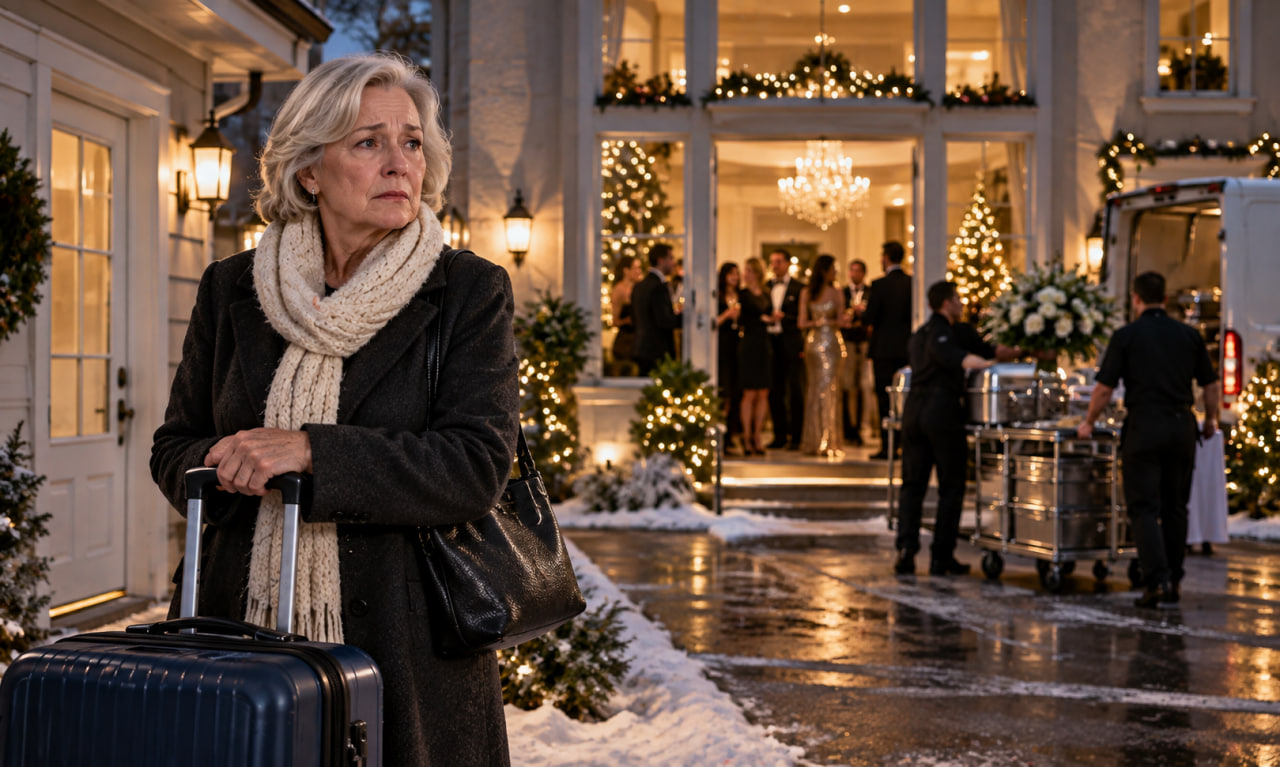
The night I had packed one suitcase and walked away.
I thought about how terrified I had been.
I thought I was losing my daughter.
But I had learned something important.
Sometimes love means opening your arms.
Sometimes love means saying no.
Sometimes love means letting someone struggle long enough to discover their own strength.
And sometimes the hardest thing a mother can do is stop rescuing the person she loves.
I turned toward Sarah.
She was watching the fireworks with tears in her eyes.
“What are you thinking?” I asked.
She smiled.
“That I’m lucky.”
I raised an eyebrow.
“Why?”
“Because you finally stopped letting me take you for granted.”
I laughed softly.
“That’s a strange definition of lucky.”
She shook her head.
“No.”
She took my hand.
“It’s the best definition I’ve ever had.”
The clock on my phone changed to 12:01.
A new year.
A new life.
And this time, when my daughter called my name, I didn’t hear desperation in her voice.
I heard love.
“Mom?”
“Yes?”
“Happy New Year.”
I looked at the woman she had become.
Then I looked at the ocean.
“Happy New Year, Sarah.”
And for the first time in many years, I didn’t wonder whether I had done enough.
I knew I had.
Because I had finally learned that being a good mother didn’t mean giving your child everything.
It meant loving them enough to let them become responsible for their own lives.
The house was gone.
The money was gone.
The years we lost were gone.
But somehow, we had found something worth more than all of it.
We had found each other again.
Not as mother and dependent daughter.
Not as provider and recipient.
But as two grown women who finally understood that love could survive boundaries.
And that was the best New Year’s gift I had ever received.