The insurance policy Dwight had left me was meant to help me live comfortably, pay medical expenses if necessary, and enjoy my remaining years without depending on anyone.
It wasn’t a family fund that my children could distribute according to their preferences.
It was mine.
I had forgotten how important that distinction was.
That afternoon, I drove to Wendell’s house again.
He was outside sanding a piece of wood when I arrived.
“You look serious,” he said.
“I’ve been thinking.”
“That’s dangerous.”
I laughed.
Then I told him about the letter.
He listened without interrupting.
When I finished, he set down his sander.
“Winnie, I don’t want to come between you and your children.”
“You haven’t.”
“I know what it feels like to lose a parent. I know what grief can do to a family.”
He looked toward the pecan tree.
“My sister and I fought for nearly a year after Mama died. Every decision became an argument. Who had visited more. Who had paid for what. Who deserved what. We forgot that we’d both lost the same person.”
“What happened?”
“We stopped speaking.”
His answer was quiet.
“Years later, I realized I would have given anything to have one more ordinary conversation with her. One more Sunday dinner. One more chance to tell her I was sorry.”
He turned back to me.
“I don’t want you to lose that chance with Zach.”
I felt tears behind my eyes.
“I don’t want to lose my son, either. But I can’t keep him by allowing him to run my life.”
“No,” Wendell said. “You can’t.”
He took my hand.
“You can love somebody and still tell them no.”
Those words stayed with me.
For the next few weeks, I did something I hadn’t done in a long time.
I started making decisions for myself.
I opened my own bank statements.
I changed the passwords to my personal accounts.
I reviewed my will.
I made an appointment with my doctor to discuss my knees and the possibility of physical therapy.
And I started attending the grief group again, not because I was drowning in grief, but because I had finally understood that moving forward didn’t mean abandoning the people we’d lost.
Sometimes it meant learning to live with their absence.
Wendell and I kept seeing each other.
We went to a little diner in town. We walked through a garden center. We sat on his porch drinking coffee while the evening light settled over the yard.
He never asked about my insurance.
Never asked about my savings.
Never asked me to pay for the renovations.
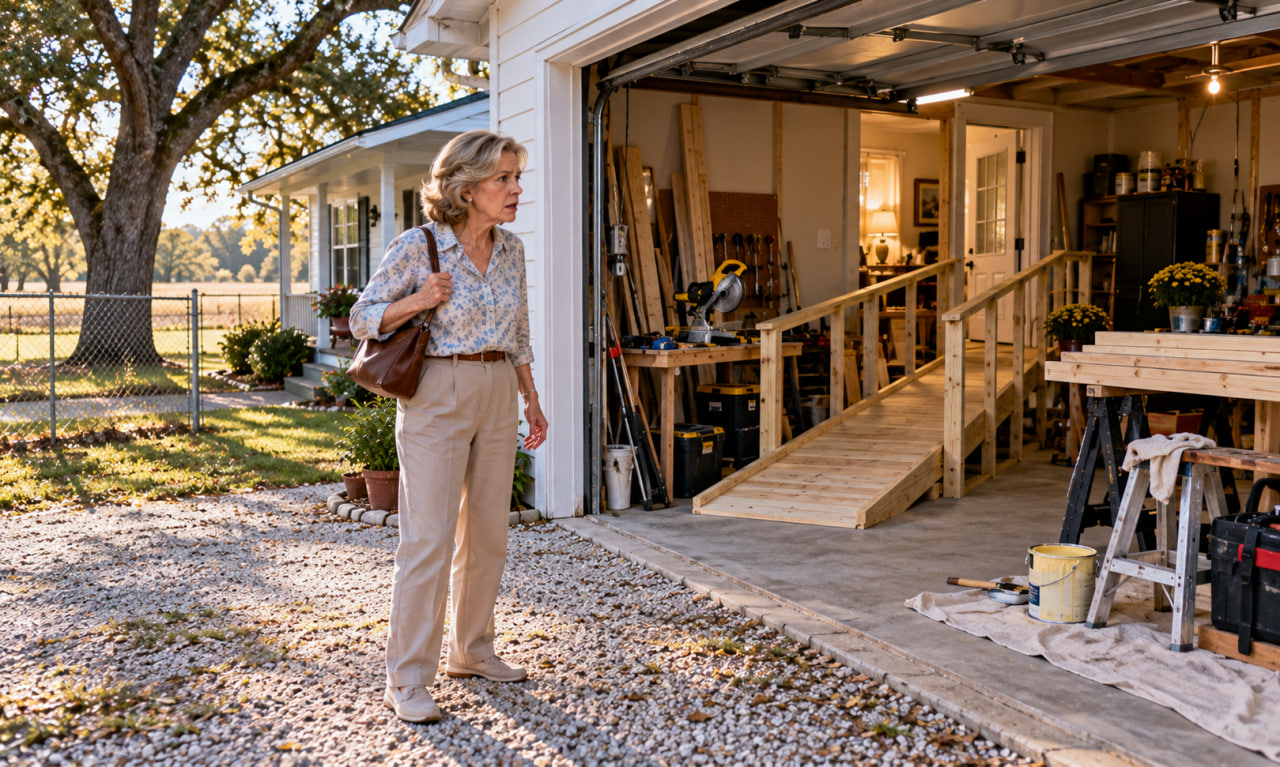
And when I offered to contribute toward the cost of the ramp, he shook his head.
“No, ma’am.”
“Wendell, I’m not offering charity.”
“I know.”
“Then let me help.”
He thought about it.
Finally, he said, “If you’d like to help, you can pick out the flowers for the front of the house.”
I blinked.
“Flowers?”
“Your choice. Whatever you want.”
I smiled.
“Well, that’s a very different conversation.”
“I thought you’d say that.”
We bought yellow roses and purple coneflowers the following Saturday.
I insisted on paying for them.
He insisted on carrying them.
We compromised by letting me choose the flowers and him doing the heavy lifting.
It was the first time in years I had felt like I was building something rather than simply maintaining what remained.
Then, one Friday afternoon, Zach appeared at my door.
Alone.
He looked tired.
His shirt was wrinkled, and he had dark circles beneath his eyes.
“Mama, can we talk?”
I stepped aside.
“Of course.”
He sat at the kitchen table.
For a while, he said nothing.
Then he looked at the chair where Dwight used to sit.
“I miss Dad.”
The words broke something open inside me.
“So do I, baby.”
He rubbed his face.
“After he died, I kept thinking I had to take care of everything. The house. The accounts. You. Megan. Everybody.”
I sat opposite him.
“Nobody asked you to take care of everything.”
“I know.”
He swallowed.
“I thought if I kept control of the money, at least nothing bad could happen.”
I waited.
“Then you started seeing Wendell, and I got scared. I thought you’d give him everything Dad worked for.”
“Did I ever say I intended to?”
“No.”
“Did Wendell ever ask me for money?”
“No.”
“Then why did you accuse him?”
Zach lowered his head.
“Because I was afraid.”
I wanted to reach across the table and comfort him.
That instinct was as old as motherhood itself.
But this time, I didn’t rush to rescue him from the consequences of his actions.
Fear could explain what he’d done.
It couldn’t make it acceptable.
“Zach, I love you. But you hurt me.”
He nodded.
“I know.”
“You embarrassed me in front of my grandchildren. You threatened to keep them away from me. You made me feel like I had to defend my right to be happy.”
His eyes filled with tears.
“I’m sorry, Mama.”
I believed that he was sorry.
But I also knew an apology was only the beginning.
“There’s something else,” I said.
He looked up.
“The paperwork you started.”
His expression changed.
“I wasn’t trying to take your money.”
“Then what were you trying to do?”
“I thought maybe it would be easier if I handled more of the bills.”
“Without asking me?”
He looked down.
“I made a mistake.”
“Yes, you did.”
The words were painful, but they were necessary.
I took his hand.
“You’re my son. I want you in my life. I want you at Sunday supper. I want my grandchildren to run through this house and make too much noise.”
He managed a small smile.
“But I will not give up control of my life to prove that I love you.”
He nodded slowly.
“I understand.”
I hoped he did.
Before he left, he asked one question.
“Do you really love Wendell?”