I hugged him.
“So am I.”
And that was the truth.
At sixty-four, I was learning things I should have understood years earlier.
That love wasn’t ownership.
That grief didn’t have an expiration date.
That being a mother didn’t mean surrendering every part of myself to my children.
And that a person could honor a beautiful past without refusing a beautiful future.
The next November marked three years since Dwight died.
I visited his grave in the morning and brought yellow roses.
I told him about the grandchildren, about Megan’s new job, about Zach’s business, and about the flowers growing beside Wendell’s kitchen.
I told him I still missed him.
Then I told him I was happy.
It was the hardest sentence to say.
And the easiest to mean.
That afternoon, Wendell picked me up for supper.
He didn’t ask whether I wanted to go to his house.
He didn’t need to.
I knew the way.
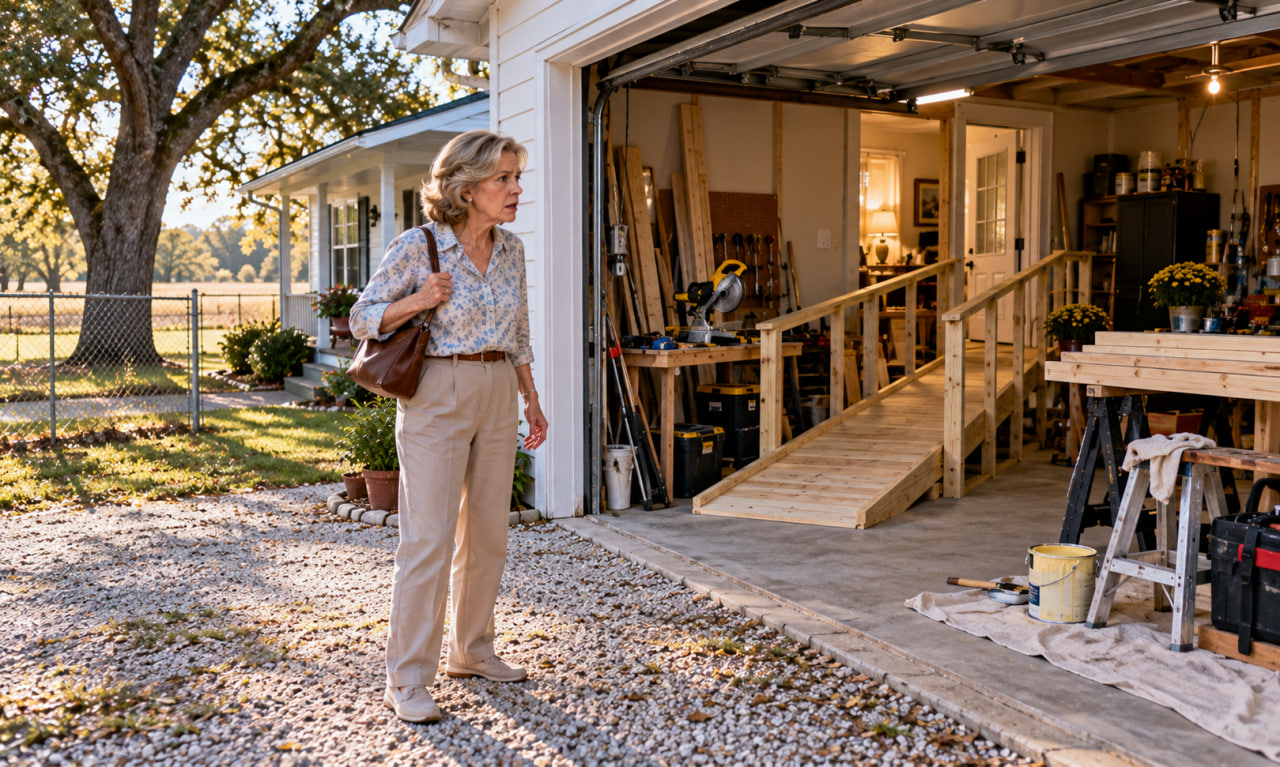
When we arrived, the garage door was open, and the ramp stretched toward the front door, weathered now from rain and sunshine.
I walked up it slowly, one hand resting on the railing.
At the top, I turned around.
Wendell stood in the driveway, watching me.
“What?” I asked.
“Nothing.”
“You’re staring.”
“I know.”
“Why?”
He smiled.
“Because I still can’t believe you came.”
I walked back down a few steps and held out my hand.
“Well, you’d better get used to it.”
He took it.
And together, we went inside.
The kitchen was warm.
The yellow walls glowed.
The flowers outside the window moved gently in the breeze.
And on the refrigerator, beneath the photograph of his mother, the old list was still there.
Most of the tasks had been crossed off.
The ramp.
The bathroom rails.
The kitchen.
The back door.
But the final line remained.
Ask Winnie to dinner.
I pointed at it.
“You never crossed that one off.”
Wendell looked at the list.
Then at me.
“No,” he said softly. “I think I’ll leave that one there.”
“Why?”
He took my hand.
“Because every time I ask you, you still say yes.”
I leaned against him.
And I understood, at last, what that house had really been hiding.
Not a wife.
Not a secret fortune.
Not a man waiting to take advantage of a lonely widow.
It had been hiding a promise.
A promise to a mother who could no longer walk through her own front door without help.
A promise to a woman who had spent years believing her best days were behind her.
And a promise to himself that the rest of his life would be built on kindness instead of regret.
My son had been afraid someone would take something from me.
But the truth was that I had almost allowed fear to take something far more precious.
My chance to live.
Now, when people ask how Wendell and I met, I tell them about the grief group, the coffee with two creams, and the porch light he repaired.
Sometimes I tell them about the garage.
And sometimes I tell them about the day I drove forty minutes down a country road because my son had convinced me the man I loved was hiding something terrible.
He was hiding something, all right.
He was hiding a yellow kitchen, a ramp, a garden, and a second chance.
And I’m glad I went looking.
Because I was sixty-four years old.
I was a widow.
I had buried the man I thought I’d grow old with.
And I had learned that the heart doesn’t stop needing love just because it has been broken.
Sometimes it needs time.
Sometimes it needs courage.
And sometimes it needs a little yellow paint.