PART5
I looked down at the folder on my desk.
“I don’t want revenge.”
“Then don’t chase revenge. Protect your name. Let the process work. Those are two different things.”
He was right.
And for the first time since the breakfast incident, I felt the pressure in my chest ease.
I didn’t need to punish Britney.
I needed to make sure she could never quietly transfer the consequences of her choices onto me again.
The following Monday, my father called while I was leaving work.
I answered because I wanted to hear what he had to say without my mother speaking over him.
“Your sister wants to talk to you,” he said.
“About what?”
“She wants to explain.”
“Then she can send me a message.”
“She wants to do it in person.”
“No.”
“She’s your sister.”
“Dad, we’ve already discussed that.”
He sighed.
“She’s scared.”
I stopped beside my vehicle.
“Scared of what?”
“The bank. The questions. Everything.”
“Did she submit the applications?”
Another long pause.
“She says she didn’t intend to hurt you.”
That was not an answer.
I waited.
Finally, my father said, “She admitted she used some of your information.”
My fingers tightened around my keys.
“What does that mean?”
“She said she thought it would help her get approved. She thought it was something you could work out later.”
“Did she have my permission?”
“No.”
The word came out so quietly that I almost missed it.
For six weeks, I had wondered whether my parents knew more than they were telling me.
Now I had my answer.
“How did she get my information?” I asked.
“She said she found some old paperwork.”
“Where?”
“At the house.”
I closed my eyes.
I could picture the filing cabinet in my parents’ spare room. The one my mother had filled with old tax documents, insurance papers, and envelopes she insisted nobody should throw away.
My personal information had been sitting in that house for years.
Britney had known where to find it.
And she had used it without asking.
“Did she tell you how many applications she submitted?”
“She says she only wanted to get the car.”
“Then why was there a personal loan application?”
“I don’t know.”
“Did she apply for anything else?”
“I don’t know.”
I took a slow breath.
“Dad, I’m not going to speculate. The investigators and financial institutions can review the records. But I’m not withdrawing my reports.”
“Your mother thinks you should.”
“Your mother is not the one whose name was used.”
He became defensive.
“You’re acting like you don’t care about your family.”
I looked across the parking lot at the soldiers walking toward the barracks, their conversations ordinary and their lives temporarily uncomplicated.
“I cared enough to send Britney four thousand dollars when she was about to be evicted. I cared enough to repair the damage from the store card she involved me in. I cared enough to keep quiet when everyone assumed I would fix whatever went wrong.”
My voice cracked slightly, and I hated that it did.
“But when she burned my face, nobody asked her to leave. When she used my information, nobody told her to stop. The only thing anyone has asked me to do is make it easier for her.”
My father didn’t speak.
I continued.
“I’m not asking you to choose between your children. I’m asking you to stop choosing her version of events over the evidence.”
Then I ended the call.
I sat in my vehicle for several minutes before starting the engine.
For the first time, my father’s silence had felt less like disapproval and more like the uncomfortable beginning of understanding.
It wasn’t enough.
But it was something.
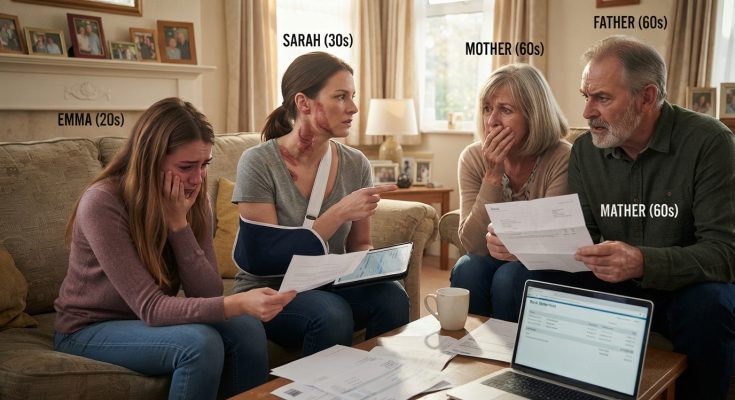
The real turning point came two days later, when my mother sent me a photograph.
It showed a document lying on the oak kitchen table.
The same table where Britney had thrown the coffee.
The same table where my father had stared at his eggs while my sister treated my refusal like an offense.
My mother had circled a paragraph in red.
Applicant’s relationship to co-applicant: Sister.
Below it was my full legal name.
The document appeared to be part of a loan application. My mother said she had found it in a folder Britney had left in the living room.
I enlarged the photograph.
There were sections I couldn’t read clearly, and I wasn’t going to draw conclusions from a blurry image. But one detail stood out.
A signature line.
It carried a name that looked similar to mine.
Similar.
Not identical.
I had signed enough official documents throughout my career to recognize the difference between my own signature and a hurried imitation.
I saved the photograph and immediately asked my mother not to write on, discard, or alter the original document.
Then I told her to preserve it and follow the instructions provided by the appropriate authorities if they requested it.
I did not ask her to confront Britney.
I did not tell her to search Britney’s belongings.
I did not want the evidence disturbed or another argument to turn physical.
I simply wanted the document preserved.
My mother called less than ten minutes later.
“I didn’t know she had done this,” she whispered.
I sat down.
“What did you think she had done?”
“I thought she had asked you to help her with the loan.”
“She did ask me. I said no.”
“I know.”
“Then what did you think happened?”
My mother started crying.
She said Britney had told them that I had agreed to help her but had later changed my mind. She had claimed I was angry about the car and was trying to punish her by refusing to cooperate with the bank.
According to my mother, Britney had even said I was exaggerating the coffee incident because I wanted an excuse to cut the family off.
I felt something cold settle inside me.
She had not only used my information.
She had used the distance between us to tell a different story about what happened.
And my parents had believed her because her story required them to do nothing.
“Mom,” I said, “you saw what happened in that kitchen.”
“I know.”
“You saw me leave for urgent care.”
“I know.”
“You saw me pack my bags.”
Her crying grew louder.
“I should have stopped her.”
“Yes,” I said.
The word surprised both of us.
For years, I would have rushed to comfort her. I would have said she couldn’t have known, that everything would be all right, that we could move forward if everyone tried harder.
But I was tired of making other people feel better before I was allowed to acknowledge what they had done.
“Yes, you should have stopped her. Dad should have stopped her. And neither of you should have asked me to pretend the loan applications were harmless.”
“I was afraid of losing both my children.”
I stared at the floor.
“You were afraid of an argument. I was the one who got hurt.”
She fell silent.
Then she said, “I am sorry.”
It was the first apology I had received from either parent since the coffee incident.
I wanted to accept it immediately.
I wanted to believe that those three words could repair six weeks of silence, years of excuses, and the terrible feeling that my own home had become somewhere I needed protection from.
But an apology could be a beginning without being a solution.


One Comment on “PART5: My Sister Threw Hot Coffee in My Face When I Refused to Give Her My Credit Card…”
Comments are closed.