PART6
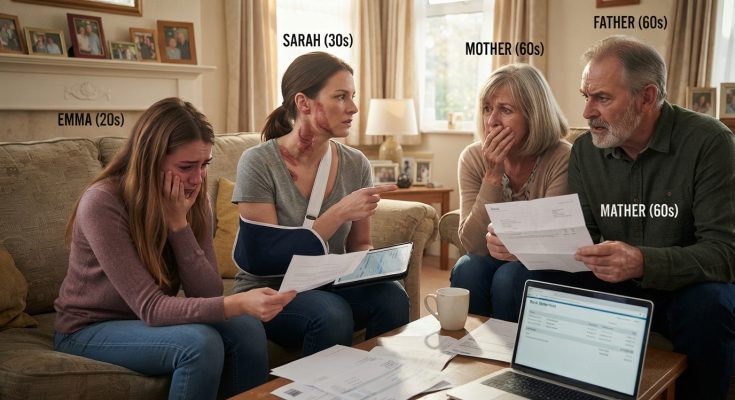
“Thank you for saying that,” I told her. “I need you to understand that I’m not withdrawing the reports. I’m not going to say I authorized those applications when I didn’t. And I’m not going to lend Britney my credit to get her out of this.”
My mother sniffed.
“She says she might lose everything.”
“Then she needs to deal honestly with what happened.”
“Can you ever forgive her?”
I looked at the photograph again.
“I don’t know yet.”
And for once, my mother did not demand a different answer.
Over the next two weeks, the situation became more complicated.
The finance company requested additional information from me. I provided the documentation I had and answered the questions truthfully.
I also completed the identity theft reporting steps recommended by the relevant institutions and kept copies of everything I submitted.
The financial institutions had to determine what had happened and what records they could disclose. I understood that a suspicious application was not, by itself, proof of every detail of someone’s conduct.
I wasn’t going to pretend otherwise.
But I knew what I had and hadn’t authorized.
And I was determined to keep that distinction clear.
Then came the discovery that changed the entire picture.
My father called on a Thursday evening.
His voice sounded older than it had a month earlier.
“There’s something else you need to know.”
I put down the book I had been reading.
“What is it?”
“Your sister used your information for more than the car loan.”
I sat up.
“How do you know?”
“She told your mother.”
“What else?”
He hesitated.
“She opened a retail financing account.”
I closed my eyes.
“Under my name?”
“She says she intended to put herself down as the person responsible for the payments. She thought the account would be easier to get approved if she used your details.”
“Did she have permission?”
“No.”
I pressed my fingertips against my forehead.
“How much?”
“I don’t know the exact amount.”
“Find out from the records. Don’t guess.”
He told me that my mother had found statements and account notices in the same folder as the loan application. They appeared to be associated with a purchase Britney had made several weeks earlier.
I asked him to preserve the documents and not to send me anyone else’s private financial information unnecessarily.
Then I checked my credit reports again.
There it was.
An unfamiliar retail credit inquiry.
I had already disputed it, but now I had a potential explanation for it.
I updated my records and contacted the company through its official fraud process.
The next morning, I received a message from Britney.
It was the first direct message she had sent since the coffee incident.
Britney: You need to call me. This has gotten completely out of control.
I read it without responding.
Another message appeared.
Britney: I never wanted you to lose anything.
Then another.
Britney: You know I was desperate. You could have helped me instead of doing this.
I put the phone face down.
She still didn’t understand.
In her mind, the problem wasn’t that she had used my information without permission.
The problem was that I had refused to absorb the consequences.
That afternoon, I finally replied.
Me: I did help you before. I gave you money when you were facing eviction, and I helped resolve the financial problems that followed. I said no to the car loan, and you used my information anyway. I will cooperate with the institutions reviewing the applications, but I will not accept responsibility for debts I did not authorize.
She called immediately.
I let it ring.
Then she sent a voice message.
Her voice was shaky, but there was anger beneath it.
“You think you’re better than me because you have your Army job and your perfect credit. You’ve always been able to walk away from things. I don’t have that luxury. You don’t understand what it’s like to have everybody judge you because you can’t get ahead.”
I listened to it twice.
There was a time when those words would have made me feel guilty.
I would have wondered whether I had been too harsh, whether I should have given her another chance, whether being a good sister meant accepting one more risk.
But I had finally learned something important.
Understanding why someone was desperate did not mean I had to give them permission to harm me.
I typed one final message.
Me: I hope you get the help you need. But my answer remains no.
Then I stopped responding.
The message from my father arrived on a Sunday morning.
Dad: We need to talk about what happened at breakfast.
I stared at it for a long time.
Those were the words I had wanted to hear six weeks earlier.
Not Britney is upset.
Not Your mother is worried.
Not The bank is asking questions.
Just an acknowledgment that something had happened at breakfast, that it mattered, and that it could not be erased by pretending everyone had simply lost their temper.
I called him.
He answered with a tired sigh.
“Your mother and I have been talking,” he said.
“About what?”
“About everything.”
I waited.
“We should have stopped Britney when she threw the coffee. We should have made sure you were all right before worrying about what the neighbors might think. And we shouldn’t have asked you to leave the house.”
I gripped the phone more tightly.
My father was not a man who apologized easily. He had spent most of my childhood believing that admitting fault weakened authority.
Hearing him acknowledge what had happened felt strange.
“Thank you,” I said.
He cleared his throat.
“That doesn’t fix anything.”
“No, it doesn’t.”
“We know.”
For a moment, neither of us spoke.
Then he told me that Britney had admitted she submitted the applications using information she found in the house. He said she had believed that if she got approved, she could make the payments herself and avoid telling anyone how bad her financial situation had become.
I asked whether she had acknowledged using a signature that wasn’t mine.
He said he didn’t know enough to answer that question.
I told him the appropriate institutions would have to review the records.
He agreed.
Then he said something that made me put my feet flat on the floor.
“Your mother and I have also decided something about the house.”
I waited.
“We’re going to secure the filing cabinet, review our own accounts, and stop keeping everyone’s personal information in a place where anyone can access it. We’ve already contacted the companies we use to make sure our own accounts are protected.”
“That’s sensible.”
“And Britney won’t be allowed to use the house as an excuse to access your documents again.”
I let out a slow breath.
It wasn’t justice. It wasn’t a complete solution. And it certainly didn’t erase the burn on my face or the fear that someone could still try to use my identity.
But it was the first time my parents had taken a concrete step without asking me to do the work for them.
My father paused.
“There’s one more thing.”
“What?”
“Your mother wants you to come home for Thanksgiving.”
I looked out the window.
The Colorado mountains were far away, but I could still picture the house, the porch, the old oak table, and the kitchen where everything had changed.
“I’ll think about it,” I said.
He accepted that answer.
And when we ended the call, I realized something I hadn’t understood before.


One Comment on “PART6: My Sister Threw Hot Coffee in My Face When I Refused to Give Her My Credit Card…”
Comments are closed.