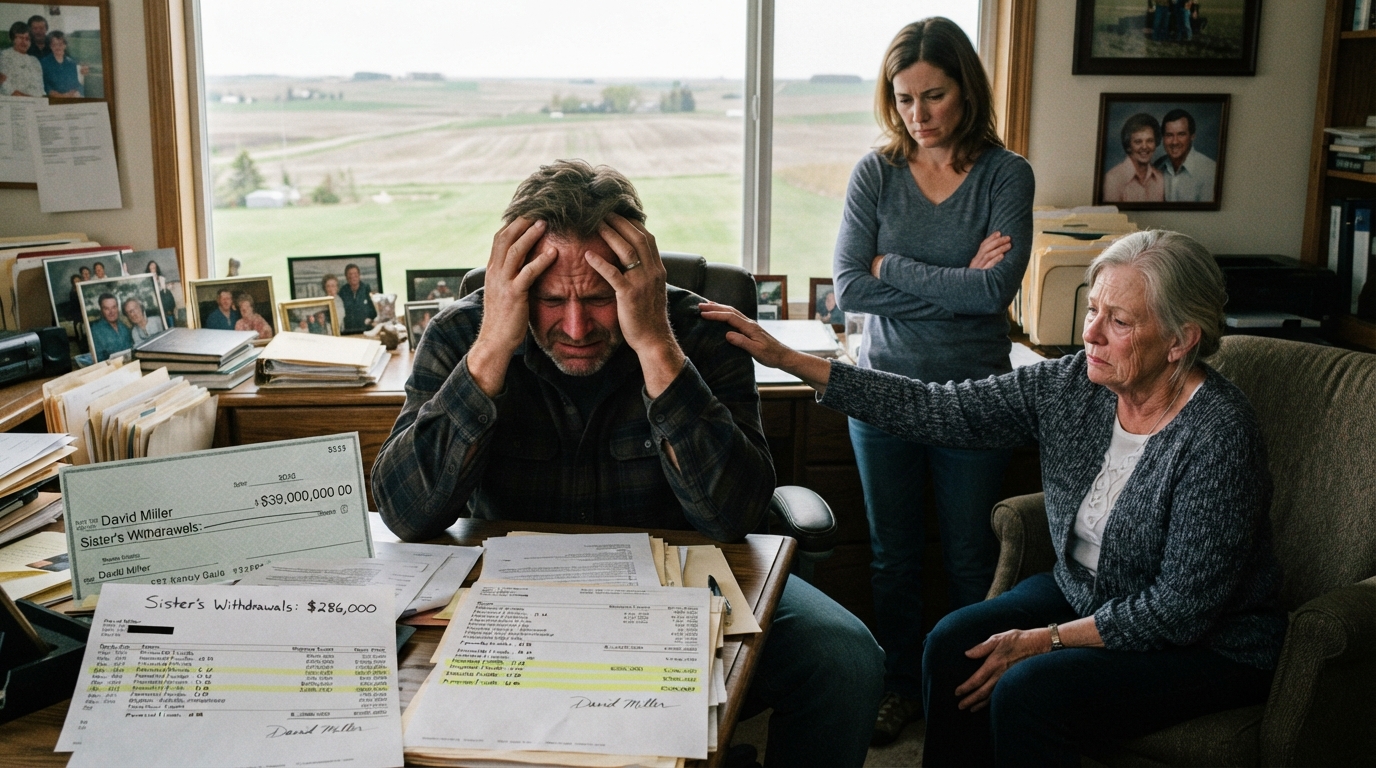
PART6
“No. Your father delayed it because he said he wanted to discuss it with you first. That was when he called Ranata and asked for more details. She gave him another explanation, and eventually he asked to see the records of the previous payments.”
I leaned against the railing.
The $80,000 request had been stopped before the money left my parents’ hands.
If Dad hadn’t asked questions, the amount in those records might have been even larger.
“Why are you telling me this now?” I asked.
“Because I think she was going to keep asking for money. And because I don’t know whether she’s been honest with me about anything related to this.”
He looked ashamed.
“I love my wife. But I can’t keep confusing love with believing every word she says.”
I studied him for a moment.
“Do you think she knew about the farm sale?”
He shook his head.
“No. I don’t think she did. If she had known, I doubt she would have kept telling your parents you were desperate for money.”
That made sense.
The sale had been private. My attorney, accountant, and the buyer’s representatives had known about it, but I had deliberately kept the news away from my family until everything was finalized.
Ranata had built her story around the assumption that I was still the struggling younger sister who could be used to explain away almost any financial request.
She hadn’t known that the story was about to collapse.
Desmond lowered his voice.
“Fay, I need to ask you something. If my wife asks you for money now, please don’t give it to her without understanding exactly what it’s for.”
I looked at him.
“I wasn’t planning to.”
“Good.”
He hesitated.
“And if she tells you that I knew everything, please don’t automatically believe that either. I knew some things didn’t add up. I didn’t know the full picture, and I didn’t have all these records until recently. But I should have done more.”
I appreciated that he didn’t try to make himself completely innocent.
People who were genuinely sorry didn’t always have perfect explanations.
Sometimes they simply admitted where they had failed.
When we returned to the kitchen, Ranata was standing beside the window, looking at her phone.
Dad had put the documents into a folder.
Mom was wiping her eyes.
I picked up my coat.
“I think I’m going home.”
Mom stood.
“Already?”
“It’s been a long day.”
She looked as though she wanted to ask me to stay, but she stopped herself.
Then she said, “Can I call you tomorrow?”
“Of course.”
“And can we have lunch sometime next week? Just the two of us?”
I nodded.
“I’d like that.”
Dad rose from his chair.
“Fay, I want you to know something. Whatever happens with this money, I don’t want you to think that we believe you did anything wrong.”
“I appreciate that.”
He glanced toward Ranata.
“I also don’t want you to think that we are going to ignore what happened.”
I looked at him.
“Good.”
As I walked toward the door, Ranata finally spoke.
“So that’s it? You’re just going to walk away and leave everyone thinking I’m a terrible person?”
I turned around.
“No, Ranata. I’m walking away because I don’t want another argument tonight.”
“You could at least help explain things.”
“Explain what?”
She hesitated.
“You know what.”
“No. I don’t.”
She looked toward our parents.
For one brief moment, I saw the same expression I had seen on her face as a child whenever she was caught doing something she knew was wrong. It was the look of someone who wanted the consequences to disappear before she had to admit what had happened.
I opened the door.
“Tomorrow, the records will still be here. So will the questions. If you have an explanation, you can give it then.”
Then I left.
On the drive home, I kept thinking about the $39 million in my account.
Three days earlier, that money had represented freedom.
Freedom from the farm’s daily demands. Freedom to decide what I wanted to do next. Freedom to take a breath after fifteen years of hard work.
Now it felt almost irrelevant.
I had thought the sale would be the biggest change in my life.
Instead, it had exposed a problem that had been growing for years.
When I arrived home, I walked into my office and sat at my desk.
The brown folder lay beside my laptop.
I opened it and looked at the closing statement again.
The numbers were still there.
The money was still mine.
But I no longer felt the urge to look at the account balance.
Instead, I opened a new document and wrote down everything I remembered from the evening.
The dates on the transfers.
The false explanations.
The unanswered questions.
The request for another $80,000.
I wasn’t trying to build a case against my sister out of anger.
I was trying to protect myself and help my parents understand what had happened to their money.
Before going to bed, I sent a message to my accountant.
I asked him to review my financial records and confirm that there had never been any payments from my parents or Ranata connected to the farm.
Then I contacted my attorney and requested a meeting.
I didn’t tell him everything over text.
I simply said there was a family financial matter involving money that had apparently been collected in my name, and I wanted advice on how to preserve the relevant records and determine what steps might be appropriate.
His reply came the next morning.
I can meet with you at ten. Bring whatever documents you have, and don’t make any financial commitments until we’ve reviewed the situation.
I read the message twice.
Then I made coffee and went outside.
For fifteen years, the farm had taught me patience.
There were seasons when the work was exhausting and the results were uncertain. There were days when equipment broke, weather ruined plans, or a problem took weeks to solve.
I had learned that panic rarely improved anything.
You identified the problem.
You gathered the facts.
Then you decided what to do.
I intended to handle this the same way.
But I had no idea that by the end of the following week, the truth would become even more complicated than the records suggested.
Because at 8:16 that morning, while I was preparing to leave for my attorney’s office, my phone rang.
It was Desmond.
He sounded as though he hadn’t slept.
“Fay, I’m sorry to call so early.”
“What’s wrong?”
“I found another account.”
I stopped walking.
“What account?”


One Comment on “PART6: I Sold My Farm for $39 Million, Then Discovered My Sister Had Been Taking $286,000 From Our Parents in My Name”
Comments are closed.