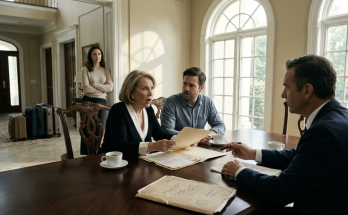
Richard fell silent, but I noticed his hand tighten around the brown envelope he had carried inside.
Whatever was inside it, he had not forgotten about it.
Neither had I.
That evening, Mauro tried a different approach.
He waited until his mother and sister had gone upstairs to argue about where they would sleep. Richard had retreated to the guest room, and the house had become unusually quiet.
I was in my office when Mauro appeared in the doorway.
He had changed into a sweater and jeans. His hair was damp from a shower, and his expression had softened into the familiar look he used whenever he wanted me to believe that the anger had never really mattered.
“Babe,” he said.
I kept reading.
“Rebecca.”
I finally looked up.
“What?”
He stepped inside and closed the door.
“Can we talk like normal people?”
“We’ve been talking.”
“No. We’ve been fighting.”
“There’s a difference?”
He winced.
“Look, I know I shouldn’t have taken the card without telling you.”
“That’s a start.”
“I was going to explain everything when we got back.”
“You left me a note telling me I was responsible for paying for your vacation.”
“I was joking.”
“You charged more than seventy thousand dollars in transactions connected to that trip.”
He looked away.
“Fine. It was a bad joke.”
I closed the folder.
“Why did you do it, Mauro?”
He rubbed his hands together.
“Because my family has been under a lot of pressure.”
“Your family?”
“My dad’s business has been struggling. Jamie’s been having problems. Mom has been feeling depressed. I wanted to do something nice for them.”
“With my money.”
“With our money.”
“No. With my money.”
He sighed as if I were exhausting him.
“Why do you always have to make everything so transactional? You’re successful. You have more money than you could ever spend. You could help my family without even noticing the difference.”
That sentence was perhaps the clearest explanation of our marriage I had ever received.
In Mauro’s mind, my success had erased my right to choose.
Because I had more, he believed I owed him more.
Because I loved him, he believed I should tolerate more.
And because I had remained silent for years, he believed I always would.
“Do you know what I wanted from you?” I asked.
He looked up.
“I wanted a husband who respected me. Someone who could tell his mother that insulting his wife was unacceptable. Someone who would celebrate my success without trying to take credit for it. Someone who would ask before using my money.”
“I do respect you.”
“Then why have you spent three years allowing your mother to threaten me in my own home?”
“She’s difficult, Rebecca. You know that.”
“Why did you let Jamie call me names?”
“She’s immature.”
“Why have you been presenting my company’s achievements as your own?”
He stopped moving.
I watched him carefully.
For a moment, something like guilt appeared in his eyes.
Then it disappeared.
“I helped you build that company.”
“You introduced me to two clients. I appreciated that. But you did not build it.”
“I was there from the beginning!”
“You were there when it was convenient.”
His jaw tightened.
“So that’s it? You’re going to throw away three years of marriage because I took a credit card?”
“No, Mauro. The credit card was simply the moment you made it impossible for me to keep pretending.”
He stared at me.
Then he sat in the chair opposite my desk.
For the first time that evening, he seemed to understand that he might actually lose me.
“Rebecca, I love you.”
I wanted to believe him.
That was the saddest part.
I had loved Mauro deeply when we first met. He had been charming, ambitious, and attentive. He remembered the smallest things I told him. He would bring me coffee during late nights at the office and sit beside me while I worked on business plans.
Back then, I had mistaken his confidence for strength.
I had mistaken his attention for loyalty.
And when his family began taking more than they gave, I kept believing that the man I had married would eventually stand up for me.
But love could not survive forever on memories of what someone used to be.
“I don’t know whether you love me,” I said softly. “But I know you have become comfortable with the idea that loving you means abandoning myself.”
He lowered his eyes.
“I can change.”
“Perhaps you can.”
“Then give me a chance.”
I looked at him for a long moment.
“Change doesn’t begin when you’re afraid of losing your privileges, Mauro. It begins when you understand why your behavior was wrong, even if you never get those privileges back.”
He said nothing.
I stood.
“I’m sleeping in the guest suite tonight. Veronica will contact your attorney about the next steps.”
His face hardened immediately.
“So you’ve already decided to divorce me.”
“I’ve decided that I will no longer live this way. The legal process will determine what comes next.”
He rose so quickly that his chair scraped across the floor.
“You’ll regret this.”
There it was again.
The threat.
The momentary glimpse of the man he became whenever affection failed to get him what he wanted.
I walked to the door and opened it.
“No, Mauro. I regret how long it took me to get here.”
He left without another word.
I watched him walk down the hall.
Then I closed my office door and called Veronica.
“He’s beginning to understand,” I said.
“Good,” she replied. “But Rebecca, don’t confuse understanding the consequences with accepting responsibility. Keep everything documented, and don’t make any financial or legal decisions without reviewing them first.”
“I won’t.”
“And one more thing.”
“What?”
“Richard called my office this afternoon.”
I straightened.
“Richard? Mauro’s father?”
“Yes. He asked whether he could provide information relevant to the financial review.”
I glanced toward the hallway.
“What kind of information?”
“He wouldn’t discuss the details over the phone. He said he wanted to speak with you privately.”
I remembered the brown envelope.
“Did he mention an envelope?”
Veronica paused.
“He did.”
My stomach tightened.
“What did he say was inside it?”
“Only that it concerned Mauro’s financial situation and something he should have told you a long time ago.”
I looked at the closed door.
For three years, I had believed that Mauro’s family was united by one common purpose: preserving their comfortable lifestyle at my expense.
Now I wondered whether there were things happening beneath that surface even I had not understood.
“Arrange a meeting,” I told Veronica.
“I already have. Tomorrow morning.”
When I hung up, I remained at my desk for several minutes.
Outside, the Chicago skyline glittered beneath the cold night sky.
The house was quiet.
But for the first time since my marriage began falling apart, I had the unsettling feeling that the truth was about to become much larger than a stolen credit card.
And somewhere upstairs, Mauro was preparing for a fight he still believed he could win.
He had no idea that his own father might be the one person capable of revealing what he had hidden.