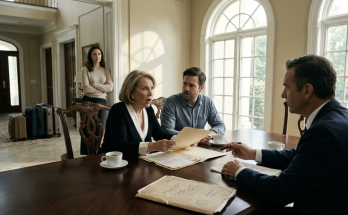
I looked at him.
“You are choosing to leave, Mauro.”
“You know what I mean.”
I did.
He wanted me to stop him.
He wanted me to cry, to plead, to tell him that our marriage was worth saving at any cost.
He wanted proof that, beneath all my anger, I was still willing to sacrifice myself to preserve the person he believed he was.
But I had already given him years of chances.
“I hope you figure out what you want your life to be,” I told him. “But I cannot figure it out for you.”
His eyes grew wet.
For a moment, he looked like the man I had once loved.
Then he picked up his suitcases and walked away.
The front door closed behind him.
I stood there for several minutes, listening to the silence.
I expected to feel triumphant.
Instead, I felt grief.
Not because I regretted my decision, but because ending a marriage meant saying goodbye to the future I had once imagined.
I had loved him.
I had believed in him.
And I had hoped that one day he would become the partner I needed.
Accepting that he might never become that person was its own kind of heartbreak.
That night, I cried for the first time since the airport call.
I cried for the years I had spent making excuses for him.
I cried for the woman I had been when I believed that patience could fix everything.
And when the tears finally stopped, I washed my face, made a cup of tea, and sat beside the window.
The house was quiet.
But it no longer felt like a place where I was waiting for someone else to decide whether I deserved to belong.
It was simply my home.
And I was finally free to live in it.
Three months later, the divorce proceedings were nearing resolution.
The financial review had concluded that certain payments required further explanation and appropriate recovery steps. My legal team pursued the matters supported by the evidence, while the relevant professionals determined whether additional action was warranted.
I never publicly accused Mauro of anything that had not been established.
I had learned that justice did not require theatrics.
It required patience, documentation, and the willingness to let facts speak for themselves.
Mauro eventually agreed to a settlement that resolved the marital issues addressed by the parties’ attorneys. The final terms reflected the applicable law, the relevant financial records, and the agreements reached during the proceedings.
He did not receive ownership of my grandfather’s trust property simply because he had lived there.
Nor did I assume responsibility for his separate business debts merely because we had been married.
The card dispute was handled through the bank’s process, and the company’s financial findings were dealt with separately.
The divorce was finalized on a rainy Friday morning.
Veronica accompanied me to the final meeting.
When everything was signed, she closed the folder and gave me a small smile.
“It’s done.”
I nodded.
“Yes.”
“How do you feel?”
I thought about the question.
“Like I’ve been holding my breath for three years and just remembered how to breathe.”
She smiled.
“Then perhaps it’s time to do something for yourself.”
I laughed softly.
“That sounds like a good idea.”
After leaving her office, I drove to the cemetery where my grandfather was buried.
He had died several years before my marriage, but he remained the person who had taught me the most about money, independence, and dignity.
When I was younger, I had once asked him why he insisted on putting his property into a trust instead of simply leaving everything to me.
He had smiled and told me something I had never forgotten.
“Money is a tool, Rebecca. It can make your life easier, but it cannot make people love you. And it should never be the price you pay to keep someone beside you.”
At the time, I thought he was speaking about business.
Now I understood that he had been speaking about life.
I placed a small bouquet beside his headstone.
“You were right, Grandpa,” I whispered.
Then I stood quietly for a while before returning to my car.
For the first time in months, I was not rushing to answer a call, solve someone else’s problem, or explain why my boundaries were reasonable.
I had nowhere I needed to be.
And that simple freedom felt more valuable than anything I owned.
Six months after the airport incident, I hosted a small dinner at my house.
Not a charity event.
Not a business gathering.
Just a few people who had stood beside me when my life became difficult.
Veronica was there, along with two longtime friends and several colleagues who had helped keep my company running smoothly during the investigation.
We ate dinner in the same room where Patricia had once threatened to throw me out.
Someone opened a bottle of wine.
Someone else told an embarrassing story about a business conference.
For the first time in years, laughter filled the house without anyone using it to disguise an insult.
Later, while the others were enjoying dessert, I stepped into the garden.
The evening air was cool, and the lights from the house reflected softly across the windows.
My phone vibrated.
It was a message from Jamie.
“Hi, Rebecca. I hope you’re doing well. I wanted to let you know that I found a job and signed a lease for a small apartment. I’m paying my own bills now. It’s harder than I expected, but it feels good.
I know we may never be close, but I wanted to thank you for not letting me continue the way I was living.
I hope you have a happy life.”
I read the message and smiled.
Then I replied.
“I’m glad you’re building a life of your own. I wish you happiness, too.”
I put my phone away.
I did not know whether Jamie would truly change, and I no longer felt responsible for making sure she did.
That was another lesson I had learned.
You can wish people well without carrying them.
You can forgive someone without restoring their access to your life.
And you can love the memories of a person without returning to the circumstances that hurt you.
I went back inside.
My friends were waiting at the table, arguing cheerfully over who had taken the last piece of cake.
I sat down and laughed with them.
For years, I had believed that keeping a family together meant tolerating almost anything.
Now I understood that a family was not held together by money, obligation, or fear of disappointing other people.
It was held together by mutual respect.
And when respect disappeared, love alone could not replace it.
Nearly a year after the day Mauro called me from the airport, I received one final message from him.
It was short.
“Rebecca, I know I cannot change what happened. I was wrong to take your card, wrong to assume you would always rescue me, and wrong to let my family treat you the way they did.
I spent a long time blaming you because it was easier than admitting what I had become.
I’ve started working again and dealing with my debts. I don’t expect you to come back. I just wanted you to know that I understand now.
I’m sorry.”
I sat with the message open on my phone for a long time.
There had been a time when those words would have been everything I wanted.