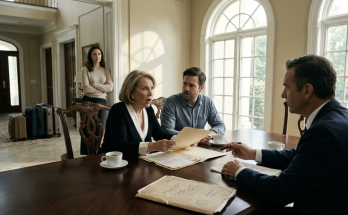
For the first time since I had known him, Richard looked directly into my eyes without embarrassment or avoidance.
“I am sorry, Rebecca. You deserved better from all of us.”
I did not immediately answer.
His apology did not erase three years of humiliation, nor did it repair the damage his silence had caused.
But unlike Mauro’s apologies, Richard’s did not come with a demand.
He was not asking me to restore a card, forgive a debt, or pretend nothing had happened.
He was simply acknowledging the truth.
“Thank you for bringing these documents,” I said. “I’ll make sure they’re handled properly.”
Richard nodded.
Then he stood and walked toward the door.
Before leaving, he turned back.
“One more thing. Mauro doesn’t know I kept that copy.”
I glanced at the document on my desk.
“Then let’s make sure he doesn’t find out until the appropriate people have reviewed it.”
Richard gave a weary nod.
And for the first time, I felt that I was no longer the only person in Mauro’s world willing to tell him no.
By noon, Veronica had arranged for the documents to be preserved and delivered to the appropriate legal and financial professionals.
My company’s independent reviewers were already examining the suspicious vendor payments. They would determine which transactions were legitimate, which required further explanation, and whether any misconduct had occurred.
I refused to jump to conclusions.
If Mauro had a legitimate explanation, he would have an opportunity to provide it.
If he had misused company funds, the evidence would speak for itself.
I had spent years building my reputation. I would not destroy it by acting recklessly simply because I was angry.
That afternoon, Mauro discovered that his father had visited my office.
He called me seventeen times.
I answered the eighteenth call.
“What did my father tell you?” he demanded.
“Good afternoon, Mauro.”
“Don’t play games with me. Dad went to see you.”
“Yes, he did.”
“What did he give you?”
I glanced at the folder beside my laptop.
“Documents relevant to the financial review.”
His breathing became audible.
“Those documents were private.”
“Some concern your business arrangements. Others concern proposed transactions involving my company. They will be reviewed through the appropriate channels.”
“You had no right to take them!”
“Your father gave them to my attorney voluntarily.”
“He had no right to do that!”
“Then you can raise that concern with your lawyer.”
He fell silent.
I could almost picture him pacing across the living room, running his fingers through his hair, searching for a threat that would make me retreat.
Finally, he said, “You have no idea what you’re doing.”
“Then explain it to me.”
“You’re trying to destroy my future.”
“No. I’m refusing to let you use my future to rescue yours.”
He hung up.
Ten minutes later, Patricia called.
Her voice was trembling with fury.
“How dare you turn Richard against his own son?”
“I didn’t turn anyone against anyone, Patricia.”
“You’ve poisoned this family!”
“Your family has been making its own decisions for years.”
She ignored me.
“Mauro is under tremendous pressure. His business has problems. Everyone has problems! A wife is supposed to stand beside her husband during difficult times.”
“Standing beside someone does not mean signing documents you haven’t approved or paying debts you didn’t create.”
“You have more money than you know what to do with!”
“And that is why you believe you can take it?”
“Don’t twist my words!”
“I’m not twisting anything. I’m finally listening to what you’ve been saying all along.”
She made a sharp, disbelieving sound.
“Fine. If you won’t help Mauro, don’t expect this family to help you when you need us.”
I looked out the window at the city below.
“Patricia, when have you ever helped me?”
She said nothing.
“When I worked late building my company, you told me I was neglecting my husband. When I attended business dinners, you accused me of caring more about strangers than family. When I paid for your apartment renovation, you called it a wife’s responsibility. When Jamie needed help with her expenses, you said I should be grateful to have the opportunity.”
“That’s not fair.”
“When did you last ask how I was doing? When did you last thank me without immediately asking for something else?”
Her breathing grew uneven.
I continued, my voice calm.
“You have mistaken my patience for weakness for so long that you no longer recognize the difference between generosity and obligation.”
Then I ended the call.
For the first time in three years, I did not feel guilty for protecting myself.
I felt free.
Two days later, Mauro arrived at my office with an attorney. He had apparently decided that the situation required a more formal approach.
His lawyer was a neatly dressed man in his fifties who introduced himself politely and asked whether we could discuss the financial and marital issues without unnecessary conflict.
Veronica agreed to meet with them in the conference room. Mauro sat opposite me, his hands folded on the table.
He looked tired, but there was still a trace of arrogance in his expression.
His lawyer began.
“My client wishes to resolve this matter as amicably as possible. He acknowledges that the credit card situation was unfortunate, but he believes there has been a misunderstanding regarding the financial arrangements between the parties.”
Veronica opened her notebook.
“Please identify the specific misunderstanding.”
The lawyer glanced at Mauro.
“My client understood that the card was available for family expenses.”
“Did he have Rebecca’s authorization to take it?”
Mauro shifted in his chair.
“I believed she would approve the trip.”
“That wasn’t the question,” Veronica replied.
He pressed his lips together.
His attorney cleared his throat.
“We are prepared to discuss repayment of the disputed charges.”
“That is a separate issue,” Veronica said. “We also need to address the suspicious vendor payments and the proposed financing document bearing Rebecca’s name.”
Mauro’s expression changed.
His lawyer turned toward him.
“Which document?”