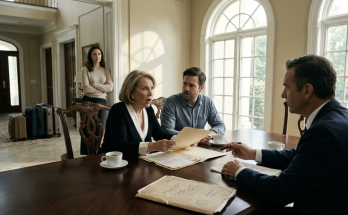
Mauro looked at the table.
Veronica placed a copy in front of the attorney.
He read it carefully.
Then he looked at Mauro again.
“Did you submit this document to anyone?”
“I was exploring financing options.”
“That wasn’t my question.”
Mauro’s jaw tightened.
“I didn’t complete the arrangement.”
“Was Rebecca’s authorization obtained?”
“No.”
The attorney removed his glasses.
“Then we need to discuss this privately.”
Mauro leaned forward.
“You’re supposed to represent me!”
“I am representing you. That includes telling you when a decision may expose you to serious legal consequences.”
For several seconds, nobody spoke.
Then Mauro looked at me.
“Rebecca, can we talk alone?”
“No.”
“Please.”
I studied him.
The word sounded unfamiliar coming from his mouth.
For years, I had been the one asking for private conversations, honest explanations, and simple consideration.
Now that the balance of power had changed, he suddenly wanted the intimacy he had repeatedly refused to protect.
“Whatever you need to say can be said with our attorneys present,” I replied.
His face reddened.
“You really hate me that much?”
“No. But I no longer trust you, and I will not confuse your discomfort with my responsibility.”
He leaned back.
The meeting continued for another hour.
No agreement was signed that day. Instead, both legal teams outlined the issues that required resolution: the disputed charges, the company’s financial review, the ownership of the property, and the separation of our personal finances.
Mauro wanted immediate access to funds.
I wanted a complete accounting.
He wanted reassurance that he would retain his comfortable lifestyle.
I wanted the legal process to determine what, if anything, he was entitled to receive.
For once, neither his anger nor his charm could change the terms.
When the meeting ended, his attorney quietly asked Veronica for a separate discussion about a possible settlement.
That was when I realized something important.
Mauro was beginning to understand that threats would not solve his problems.
But whether he was prepared to take responsibility for creating them remained an open question.
The following week brought the first formal findings from the preliminary financial review.
Some of the transactions Mauro had questioned were legitimate. Others lacked sufficient documentation. Several payments to businesses associated with his consulting firm required further examination because the supporting invoices did not match the work recorded in my company’s files.
The reviewers recommended additional investigation before reaching any final conclusions.
I approved their recommendation.
I did not want revenge disguised as business.
I wanted the truth.
Meanwhile, the bank continued its investigation into the card charges. The records confirmed that the card had been used for travel and other purchases I had not authorized. My legal team coordinated with the bank, and the disputed transactions were handled through the relevant procedures.
I refused to reactivate the card.
I also refused to pay Mauro’s personal business debts.
Those decisions enraged him.
But the consequences were no longer mine to manage.
Then, one Thursday morning, I received an email from an unfamiliar address.
The subject line read:
I OWE YOU AN APOLOGY.
It was from Jamie.
I nearly deleted it.
Instead, I opened it.
“Rebecca,
I know you probably don’t want to hear from me, but I need to say something.
For years, I believed you were lucky to have Mauro. Mom always told me that you were too ambitious, too proud, and too focused on your career to understand what family meant.
I repeated those things because they made me feel better about the fact that I depended on you.
When Mauro told us about the vacation, he said you had agreed to pay. I never asked to see the approval. I simply assumed the money would be there because it always had been.
When the card was declined, I blamed you instead of asking why it had happened.
I was wrong.
I’ve spent the last few days looking at my own life, and I don’t like what I see. I’m thirty years old, and I’ve been relying on my brother and his wife to pay for things I should have been paying for myself.
I don’t expect you to forgive me.
I just wanted you to know that I understand why you finally said no.
I’m sorry.”
I read the email twice.
Then I closed it.
I was glad Jamie had begun to recognize her behavior, but I did not owe her immediate forgiveness. An apology was a beginning, not a magic eraser.
I sent a brief reply.
“Thank you for acknowledging what happened. I hope you use this as an opportunity to build a more independent life. I wish you well.”
That was all.
For the first time, I could wish someone well without inviting them back into my life.
Patricia’s response was very different.
She refused to accept that the old arrangement was over.
She continued insisting that Mauro deserved financial support because he was my husband. She complained to relatives that I had become cruel and heartless. She even told a family friend that I was attempting to steal the family’s home.
Veronica advised me not to engage in arguments over rumors.
The property’s ownership documents were clear, and any decisions concerning occupancy would be handled according to the trust’s governing documents and applicable law.
I had no intention of throwing anyone into the street in a fit of anger.
But neither would I allow anyone to remain in my home indefinitely while threatening me.
Through our attorneys, Mauro and I agreed on a temporary arrangement while the divorce proceedings moved forward. He would stay elsewhere, and his family would make separate arrangements for their living expenses. Any questions regarding the property would be resolved formally rather than through Patricia’s demands.
When Mauro finally packed his belongings, he did so in silence.
I watched from the hallway as he carried two suitcases toward the front door.
For a moment, I remembered the day he had moved into the house after our wedding.
He had stood in the same doorway, holding a bottle of champagne, and promised that we would build a beautiful life together.
I had believed him.
Perhaps he had believed it, too.
But somewhere along the way, the life we were building had become a stage on which he performed success while expecting me to pay for the scenery.
He stopped beside me.
“Are you really going to let me walk out of here like this?”