PART4
His question hurt more than I expected.
“I have helped you. I opened my home to you. I have cooked meals, paid the additional utility bills without asking you for anything, and made room for both of you. I have done those things because I love you. But helping you does not mean I must give you everything you want.”
He rubbed his hands together.
“Serene says you have plenty of space.”
“I do. And I am willing to discuss how we can share it respectfully. But the study is not automatically a nursery, and my bedroom is not automatically yours.”
He remained quiet for a long time.
Then he asked, “Are you really going to make us leave?”
I leaned forward.
“I hope we can work this out without that happening. But I will not allow myself to be treated as though I am an inconvenience in my own home.”
His eyes lifted toward mine.
For a second, I thought he might apologize.
Instead, he stood.
“I need to think.”
“I hope you do.”
He left without another word.
I stayed in the study until the light outside began to fade.
I had not won anything.
I had simply spoken the truth.
And sometimes, the truth is the loneliest thing a person can say in a house full of family.
The following morning, I woke to the sound of drawers opening downstairs.
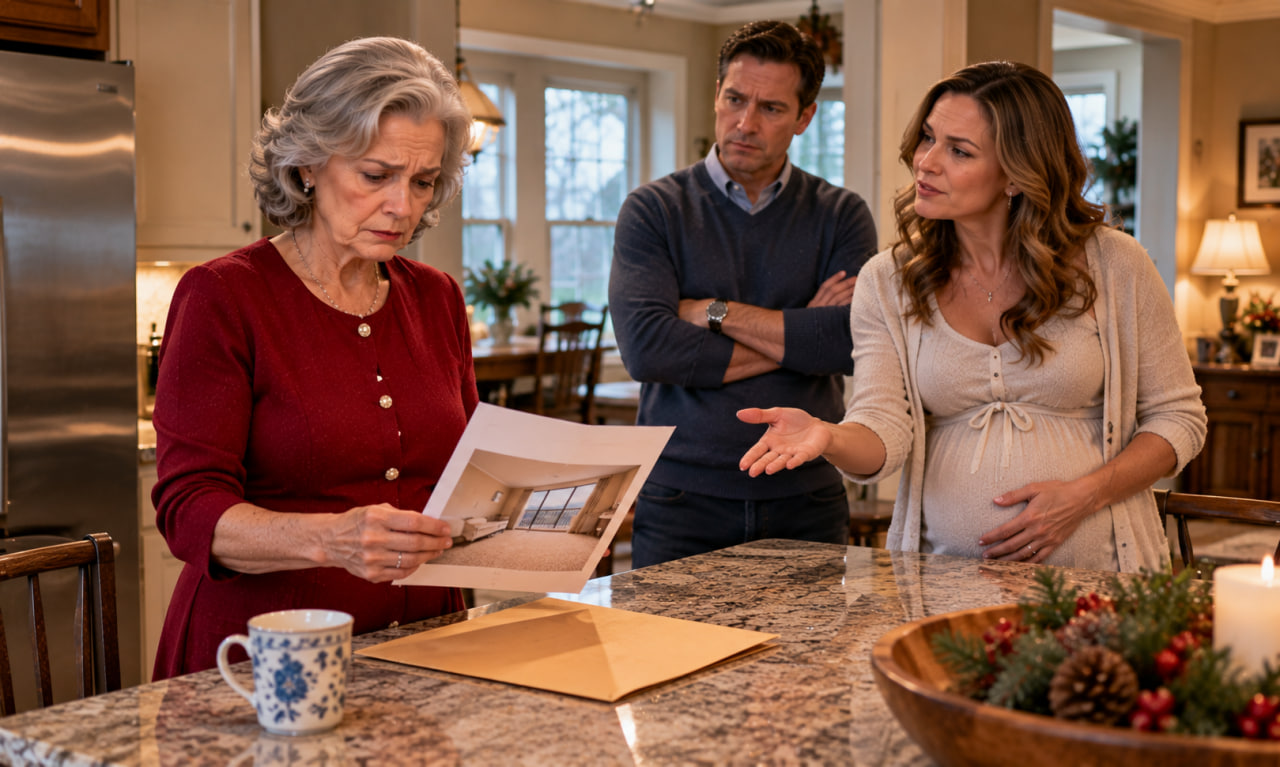
When I entered the kitchen, Serene was sorting through a stack of papers.
“What are you doing?” I asked.
“Organizing things.”
“Whose things?”
She looked up impatiently.
“Household things. Bills, receipts, documents. Someone needs to keep track of everything.”
I walked closer.
Among the papers on the counter were my property tax statements and a folder containing old insurance documents.
“Those are private,” I said.
She paused.
“I was only trying to help.”
“Then please ask before going through my documents.”
She slid the papers into a neat pile.
“Honestly, I don’t understand why you’re being so defensive. Fletcher and I are going to be responsible for this house eventually anyway.”
I felt something cold settle in my stomach.
“Who told you that?”
She blinked.
“Well, Fletcher is your only child.”
“That wasn’t my question.”
Her expression hardened.
“I’m just saying it’s normal for a house to pass to the children.”
“Eventually, perhaps. But I am alive, Serene. I own this house, and I will decide what happens to it.”
She let out a short laugh.
“You can’t expect to live here forever.”
“No,” I replied. “But neither can you expect me to disappear just because you have decided it’s your turn.”
She stared at me.
Then she picked up her phone and walked out of the kitchen.
I remained beside the counter, looking at the documents she had touched.
It was a small thing, perhaps.
But I could no longer ignore the pattern.
They weren’t simply trying to make room for a baby.
They were beginning to think of my home as an inheritance that had arrived early.
And that afternoon, I learned just how far those assumptions had gone.
I was returning from the grocery store when I heard Fletcher speaking on the phone in the garage.
“No, we haven’t decided anything yet,” he said.
A pause.
“Because Mom is making it complicated.”
I stopped outside the door.
He lowered his voice.
“Once the baby comes, she’ll understand. She won’t want to be in the way.”
I gripped the grocery bag.
Then he said something that made me forget the cold air around me.
“And if she still refuses, Serene thinks we should talk to someone about whether she’s capable of managing the property herself.”
For a moment, I couldn’t move.
Capable?
I had managed the house for twelve years after Leonard died. I paid the bills, arranged repairs, handled insurance renewals, and kept every important document organized. I drove myself to appointments, maintained my garden, and balanced my accounts without anyone’s help.
Yet my son was discussing whether I was capable of managing my own property simply because I refused to surrender it.
I stepped away from the garage before he could see me.
I put the groceries away, made myself a cup of tea, and waited until my hands stopped shaking.
Then I called Gail.
I told her exactly what I had heard.
She listened without interrupting.
When I finished, she asked, “Has either of them raised concerns about your memory, your finances, or your ability to live independently before this dispute?”
“No.”
“Have you been diagnosed with any condition that affects your decision-making?”
“No.”
“Then don’t panic. A disagreement over property does not, by itself, establish that someone is incapable of making decisions. Keep a factual record of what has happened, preserve your documents, and let me know if they take any formal action.”
I thanked her.
Before ending the call, she added, “And please remember: you do not need to prove that you deserve to remain in your own home by being endlessly patient with people who refuse to respect your boundaries.”
After I hung up, I opened my notebook.
I recorded the date, the time, and the words I had overheard as accurately as I could remember them.
Then I closed the notebook and looked at Leonard’s photograph on the mantel.
“I wish you were here,” I whispered.
The house offered no answer.
But I knew what I needed to do next.
I needed to stop hoping that everyone would suddenly understand my feelings.
I needed to make sure my wishes were protected.
And I needed to find out whether my son still understood what family meant.
Three days later, Serene announced that she had invited her parents over for Sunday lunch.
“They’re excited about the baby,” she explained. “And they want to see the house.”
I looked up from the newspaper.
“Of course. They’re welcome to visit.”
She smiled in a way that made me suspicious.
“We thought it would be nice to discuss the nursery together.”
“Discussing the nursery is fine. Deciding what happens to my house is not a group activity.”
Her smile vanished.
“Why do you always have to make things sound so unpleasant?”
“Because you keep trying to make decisions that aren’t yours to make.”
She turned away sharply.
Sunday arrived with clear skies and a cool breeze.
I spent the morning preparing lunch. I made Leonard’s favorite roast chicken, roasted potatoes, and a simple apple cake. I wasn’t going to let this conflict turn me into someone I didn’t recognize.
At noon, Serene’s parents arrived.
Her mother, Marjorie, was a tall woman with carefully styled silver-blonde hair. Her father, Dennis, was quieter, carrying a box of pastries from a bakery.
They greeted me warmly.
“Thank you for having us,” Marjorie said. “Serene tells us you’ve been making room for the baby.”
I set the plates on the table.
“We’re discussing what arrangements will work for everyone.”
Marjorie exchanged a quick glance with her daughter.
Then she smiled.
“Well, naturally, the baby needs a proper room. And this house has so much potential.”




One Comment on “PART4: My Daughter-in-Law Tried to Move Me Out of My Own House at 72—Then I Placed an Envelope on the Kitchen Counter”